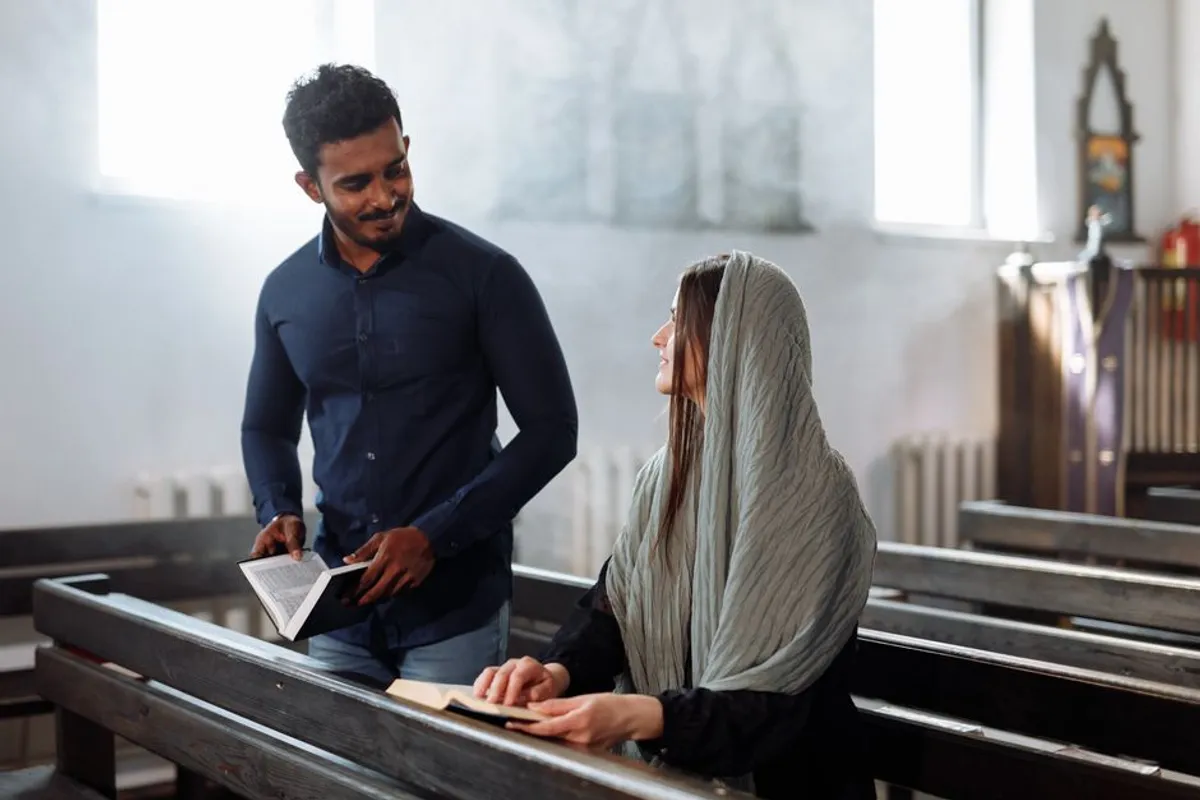
Christian marriage counseling is couples therapy where both partners and the therapist share a Christian framework. That shared starting point changes what sessions feel like — faith can be part of the conversation, not something to set aside at the door.
The work itself is familiar: communication, conflict, patterns that have formed over years. The counselors are qualified therapists. What differs is the vocabulary, the lens, and the permission to speak about what matters most to you within the context of your faith.
Communication problems and lack of emotional closeness are among the most common reasons couples enter therapy. For Christian couples, there is often an extra layer: knowing what you believe about marriage does not always make it easier to say what you feel.
In this guide:
- What makes it different from standard couples therapy
- Common reasons Christian couples seek help
- What actually happens in sessions
- How to find a Christian marriage counselor
- What to do between sessions
- Frequently asked questions
What makes Christian marriage counseling different

A licensed Christian counselor holds the same credentials as any licensed therapist — graduate training, professional registration, and the same evidence-based approaches to communication and conflict. What differs is that they are willing to draw on Scripture, prayer, and biblical principles where you want them to.
Some couples want faith woven through every session: a prayer to open, Scripture as a shared reference point, the language of covenant running through the work. Others want a therapist who understands their values without necessarily praying together. Both are legitimate. When you are looking for someone, it is worth knowing which kind of integration you are actually after.
What faith-based counseling tends to do well is hold your marriage within a broader framework of meaning. For couples whose relationship is grounded in a sense of covenant — commitment that is not contingent on whether things feel easy — a therapist who understands that frame can work with it differently. They are not trying to translate what your faith means to you. They already share it.
A secular therapist who is skilled and well-credentialed can still be the right choice. But if keeping faith out of the room feels like leaving something important behind, that is the thing to pay attention to.
For a broader look at how the therapeutic process works, our guide to couples therapy covers the main approaches and what to expect from sessions generally.
Common reasons Christian couples seek help

The reasons are, for the most part, the same reasons any couple comes. Recurring conflict that never quite resolves. A slow erosion of closeness that neither person can name. A conversation that keeps getting postponed. Research consistently finds that communication problems and lack of emotional closeness account for most of what brings couples to therapy.
There are patterns that appear more often within Christian marriages. Desire discrepancy — one partner wanting more sexual closeness than the other — is one of the most frequently reported issues in couples therapy. Within Christian marriages, it often goes unnamed for longer. There is quiet pressure to appear okay, to model the marriage the congregation expects. That pressure costs something.
Shame is the main barrier, not incompatibility. Most people carry more shame around their desires than they realise — and much of it has nothing to do with their current relationship, or even their faith tradition. A counselor who understands that dynamic, and understands the specific context of a Christian marriage, can work with it differently from someone who does not.
The other thread that comes up: feeling close to God as a couple is not the same as feeling close to each other. Shared faith is a foundation. It is not a substitute for the conversations that build closeness directly between two people.
What actually happens in sessions

The first session is mostly assessment. The counselor will ask about your relationship history, what has brought you in, and what each of you is hoping for. They will observe how you talk to each other — where the pauses are, what happens in the room when something difficult comes up. This can feel exposing. That is normal, and a good counselor will name it.
Sessions after that become more specific. The focus is usually on patterns, not individual incidents — the dynamic that keeps producing the same argument, not the argument itself. Communication, conflict, and sometimes working through something that happened and was never fully resolved.
Most couples aren’t stuck because they don’t love each other. They’re stuck because they never learned how to start the conversation. For many Christian couples, the patterns formed before the marriage did — in families where certain things were not discussed, in church contexts where emotional directness was not modelled. Therapy gives those conversations a structure they did not have before.
Prayer, Scripture, and faith-based reflection may come into sessions if you have asked for that integration. The depth is for you to decide. A good counselor will not assume you want all of it — or none of it.
Most therapists suggest reviewing progress around the twelve-session mark. Some couples address what they came for in eight to twelve sessions. Others continue for six months or more.
How to find a Christian marriage counselor

There is no single global register for Christian marriage counselors, but several directories make finding a qualified practitioner more reliable than a general search.
In the UK, the Association of Christian Counsellors (ACC) maintains a directory of registered members, including those with couples and marriage specialisations. When using any directory, check that the counselor holds a recognised clinical qualification alongside their faith-based training — MBACP, MBACP (Accred), or UKCP registration. Faith should add to clinical training, not replace it.
In the US, the American Association of Christian Counselors maintains a therapist locator at therapistlocator.net, searchable by state and area of specialisation. Focus on the Family’s Christian Counselors Network also lists vetted practitioners offering clinically trained, biblically integrative care. The same credential check applies: look for a state licence alongside any faith certification.
Internationally, the Gottman Institute’s therapist finder covers practitioners across many countries, including the UK, US, Canada, and Australia. Some therapists listed note faith integration in their profiles. It is one of the few directories with consistent international reach.
Online counseling — sessions via video call — has expanded access, particularly where local Christian counselors are sparse. The same credential check applies: look for specific training in couples or relationship work, not just a general counselling qualification.
Cost varies widely by location and experience. Training institutes, where supervised trainees see clients at reduced rates, can be a realistic option when cost is a barrier.
What to do between sessions

Therapy changes patterns. It does not replace the conversations that couples need to have with each other.
Most of the real change happens in ordinary life — the Tuesday evening when something that would have escalated becomes something different instead. Many therapists suggest something specific to notice or try between sessions: not formal homework, but a way to carry the work beyond the room. That practice is where the patterns actually shift.
There is one conversation that most couples — including couples who are talking genuinely about most things — consistently postpone: what they each want physically and sexually. Not because they do not trust each other. Because naming it feels more exposed than almost anything else. Research finds that even in safe, loving relationships, the instinct to self-protect overrides the knowledge that it is safe to say what you actually want.
For Christian couples, this layer can sit heavier. The theological understanding is there — that sexual closeness within marriage is good, intended, celebrated. But the practical language often has not followed. The church has, historically, been more comfortable blessing the institution than equipping couples for honest conversation within it. A direct discussion about desire can feel harder to start than it should be, even when both partners want to have it.
The yes, no, maybe list is a structured format used in sex therapy for decades, designed for exactly this kind of conversation. Each partner answers a set of questions about desires, limits, and areas of curiosity privately — before comparing. There is no watching each other’s faces. No adjusting your answer in real time because of how your partner looks. You see only what you share.
It does not require the conversation to have started. It is a way to start it.
For a step-by-step walkthrough of the format, how to use a yes, no, maybe list covers the practical process. Our companion post on sex in a Christian marriage explores the specific dynamics of why silence forms — and what changes when couples create space for honest answers.
Frequently asked questions
Is Christian marriage counseling only for couples in crisis?
No. Most couples who come to therapy are not in crisis — they want to communicate better, address something that keeps coming up, or have a specific conversation that has not happened yet. The earlier you go, the shorter the work tends to be.
Do both partners need to be Christian?
Not necessarily. Some counselors work with couples where faith matters to one partner and not the other. It is worth raising before you book — a good counselor will tell you honestly whether they can hold that dynamic well.
Will we be asked to pray or read Scripture in sessions?
That depends on the counselor and what you have asked for. Some integrate prayer and Scripture throughout. Others keep faith as background rather than foreground. Asking before your first session — ‘how do you integrate faith into your couples work?’ — is entirely reasonable.
Is Christian marriage counseling the same as pastoral counseling?
No. A pastor or minister can offer valuable spiritual support, but typically without clinical training in communication and relationship patterns. A Christian marriage counselor holds both a recognised professional qualification and a faith framework. For clinical concerns, the professional credential matters.
What if only one of us wants to go?
One partner can attend alone, with the relationship as the focus. It will not change your partner directly, but changing how you respond to them often shifts the dynamic between you. Some couples who begin separately eventually come together.
How long does Christian marriage counseling take?
The same range as couples therapy generally. Some couples address a specific issue in eight to twelve sessions. Others continue for six months or more. A progress review around the twelve-session mark is a good habit.
What if our church community expects us to handle this within the congregation?
A qualified Christian counselor is not in conflict with pastoral support — they offer clinical training in communication and relationship patterns that a pastoral team generally cannot. Both can coexist, and many couples find using both helpful.